Nonprofit CEO Job Description Template
Updated November 4, 2026
A nonprofit CEO leads the organization's staff and operations, advances its mission, and works with the board on strategy, resources and accountability. The precise responsibilities depend on how the organization is structured, so treat this as a starting point. Copy it, fill every bracketed field, and cut anything that is not true of the role you are hiring.
Need help tailoring the role? Customize your role with our job description builder. Ready to recruit? Post your nonprofit CEO opening.
Chief Executive Officer
About the organization
Organization name is a nonprofit organization dedicated to mission. We serve communities or beneficiaries through principal programs. Our annual operating budget is amount, and our team includes staff count and key functions, supported by volunteers, partners, or other resources. We operate in locations or service area.
Position details
Position summary
The Chief Executive Officer is responsible for leading organization name and translating its mission and board-approved strategy into effective programs, sound operations, and sustainable financial performance. The CEO leads the staff, builds relationships with supporters and partners, and provides the board with the information it needs to govern effectively.
Working within the authority delegated by the board, the CEO sets operating priorities, allocates resources, and establishes clear expectations for performance. During the first year, the CEO will focus on two to four specific organizational priorities.
Responsibilities
Mission and strategy
- Work with the board and staff to establish strategic priorities grounded in community needs, organizational capacity, and available resources.
- Translate the approved strategy into annual plans, budgets, responsibilities, and measurable outcomes.
- Review progress and recommend adjustments when results, funding, or community needs change.
Board partnership
- Provide timely, accurate information on finances, programs, staffing, and significant risks.
- Support board and committee work while respecting the distinction between board governance and staff management.
- Implement board-approved policies and decisions and raise matters that require board action.
People and operations
- Lead, support, and evaluate direct reports, with clear responsibilities and appropriate delegated authority.
- Maintain hiring, supervision, and workplace practices that support fair treatment, accountability, and effective work.
- Ensure that programs and operating systems have the staff, resources, and oversight needed to deliver reliable services.
Financial stewardship and risk
- Develop the annual budget with appropriate staff or professional support and present it to the board for approval.
- Monitor revenue, expenses, cash flow, and financial commitments; act promptly when performance differs from plan.
- Maintain appropriate financial controls and coordinate required reporting and professional reviews with responsible staff and advisers.
- Identify significant operational, financial, technology, and reputational risks and bring material concerns to the board.
Fundraising and external relationships
- Lead or support revenue development according to the organization's funding model and available fundraising staff.
- Build relationships with donors, funders, community partners, and other stakeholders relevant to the mission.
- Represent the organization accurately and ensure that commitments to partners and funders can be delivered.
Qualifications
- Leadership experience relevant to the organization's scale, mission, and operating complexity.
- Demonstrated ability to manage people, budgets, and competing priorities and to explain results clearly.
- Experience working with a governing board or comparable oversight body.
- Evidence of building productive relationships with communities, partners, funders, or customers relevant to the role.
- Experience with essential funding model, service area, or specialized requirement.
Preferred: Include only preferences that add real value. Education: State a justified requirement or describe acceptable combinations of education and experience. Prior CEO experience is required or preferred only if justified by the role.
First-year priorities
The board and CEO will agree on a realistic first-year plan. Initial priorities include priority and intended outcome, priority and intended outcome, and priority and intended outcome. Targets will reflect available resources and the organization's starting position.
How to apply
Submit requested materials through application URL or instructions by deadline, if applicable. Direct questions and requests for application accommodations to contact or process. Insert the organization's approved equal opportunity statement and relevant application information.
Before you publish: replace every bracketed field and confirm the final description with the hiring organization.
Adapt the template to your organization
Adjust the template above for the organization’s size and type. Pick the language that matches the real role, then delete what you did not use.
Choose a version by organization size
Three complete samples show how the CEO role changes as a nonprofit becomes more complex. Budget and headcount alone do not decide which one fits. Look at how much the CEO must personally execute, how much leadership capacity exists beneath the CEO, and how complex the operations and outside relationships have become.
- Small nonprofit CEO job description. Best suited to an organization with a lean staff, limited management layers, and a CEO who personally handles many operational and fundraising responsibilities.
- Medium-sized nonprofit CEO job description. Designed for an organization with established programs, several functional leaders, and a need for stronger management systems and diversified revenue.
- Large nonprofit CEO job description. Appropriate for a complex institution with multiple departments, substantial programs, significant financial responsibilities, or a broad geographic footprint.
| Leadership dimension | Small nonprofit | Medium nonprofit | Large nonprofit |
|---|---|---|---|
| CEO's daily role | Personally executes many functions | Leads managers and coordinates functions | Leads through an executive team |
| Fundraising | Direct donor and grant work | Revenue strategy plus key donor relationships | Institutional fundraising strategy and major relationships |
| Operations | Hands-on oversight | Systems and departmental accountability | Enterprise-wide operating model and controls |
| Programs | Direct involvement in delivery | Portfolio oversight and performance review | Institutional portfolio strategy and impact |
| Board relationship | Frequent, practical partnership | Governance, strategy, and performance | Governance, enterprise risk, succession, and institutional strategy |
| Financial leadership | Budget discipline and cash flow | Forecasting, diversification, and sustainability | Long-term financial strategy and major resource allocation |
| Primary leadership challenge | Doing more with limited capacity | Building management capacity and consistency | Aligning a complex institution around shared priorities |
| Leadership dimension | Small nonprofit | Medium nonprofit | Large nonprofit | | CEO's daily role | Personally executes many functions | Leads managers and coordinates functions | Leads through an executive team | | Fundraising | Direct donor and grant work | Revenue strategy plus key donor relationships | Institutional fundraising strategy and major relationships | | Operations | Hands-on oversight | Systems and departmental accountability | Enterprise-wide operating model and controls | | Programs | Direct involvement in delivery | Portfolio oversight and performance review | Institutional portfolio strategy and impact | | Board relationship | Frequent, practical partnership | Governance, strategy, and performance | Governance, enterprise risk, succession, and institutional strategy | | Financial leadership | Budget discipline and cash flow | Forecasting, diversification, and sustainability | Long-term financial strategy and major resource allocation | | Primary leadership challenge | Doing more with limited capacity | Building management capacity and consistency | Aligning a complex institution around shared priorities |
Adjust for the type of organization
- Foundation. Specify grantmaking strategy, relationships with grantees, and coordination with the board and investment advisers. Leave out fundraising duties unless the funding model requires them.
- Human services. Identify service-quality oversight, client safeguarding responsibilities, and the role of contracts and restricted funding. Confirm any credentials or regulatory duties specific to the role before adding them.
- Arts and culture. Describe how executive and artistic leadership divide the work, the mix of contributed and earned revenue, and responsibility for facilities or public programming.
- Membership association. Identify member services, retention, dues revenue, board relationships, and any responsibility for advocacy or events.
Make it yours
Customize the role with the builder
The Nonprofit C-Suite Job Description Builder asks about your size, reporting lines and the leadership challenge you are hiring for, then assembles a tailored prompt and editable templates from your answers. Review whatever it produces against the decisions your board has made before you post it.
When the description is ready, put it in front of nonprofit executives who are already looking.
Post your nonprofit jobCommon questions
Is a nonprofit CEO different from an executive director?
Not necessarily. Both titles can describe the senior staff leader. Spell out the authority, the reporting relationships and the responsibilities, because the title alone does not tell a candidate the scope of the job.
What should a nonprofit CEO job description include?
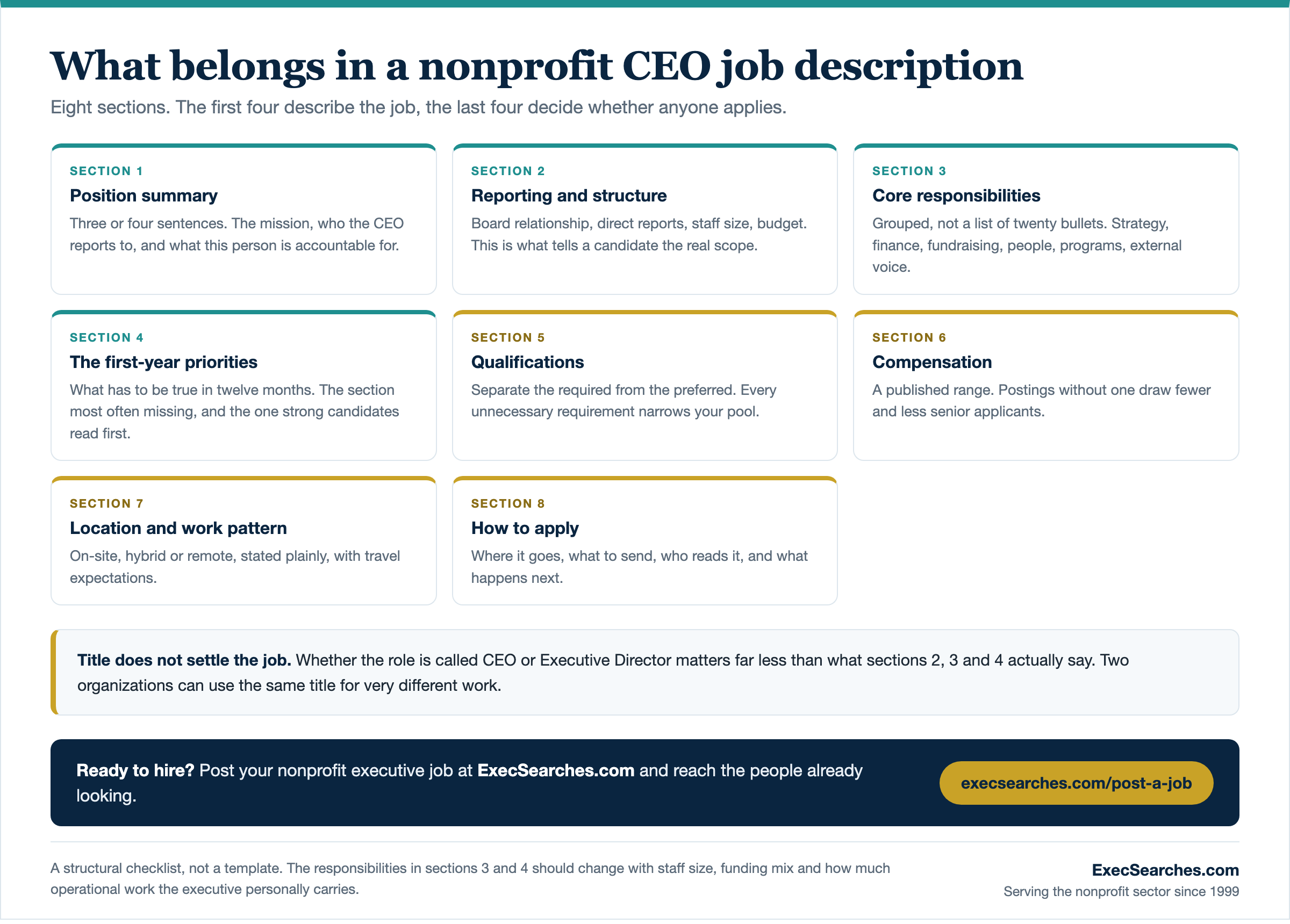
The organization's context, the position details (reporting line, direct reports, location, compensation and schedule), a position summary, grouped responsibilities, qualifications with required separated from preferred, first-year priorities, and how to apply.
Should the budget determine the qualifications?
Not on its own. Consider the budget alongside staff size, funding restrictions, program complexity, geography and the support available, then match the qualifications to the work.
Should a nonprofit job posting include a salary range?
Yes. Experienced candidates are reluctant to spend time on a role whose pay is unknown, and several states and cities now require a range in the posting. Check the rules for every location where the role can be performed.
Who should write the CEO job description, the board or the staff?
The board owns it, because the board hires and supervises the chief executive. In practice a board committee drafts it with help from staff or a search partner, and the full board approves it. Writing it before the search forces the board to agree on what it is hiring for while disagreement is still cheap.
Can we use this template for a posting?
Yes, once you adapt it. Fill every bracketed field, confirm the responsibilities and compensation, and give clear application instructions. Then submit the opening on ExecSearches.com.
Prepared by
Founder, ExecSearches.com
- Has run ExecSearches.com since 1999
- Nonprofit and public sector hiring
Executive Consultant, ExecSearches.com
- Graduate of Harvard-Radcliffe and Columbia
- Leadership selection and candidate assessment